Leadville Afterthoughts
2026-09-02 · eleven days post
Some thoughts from after the race.
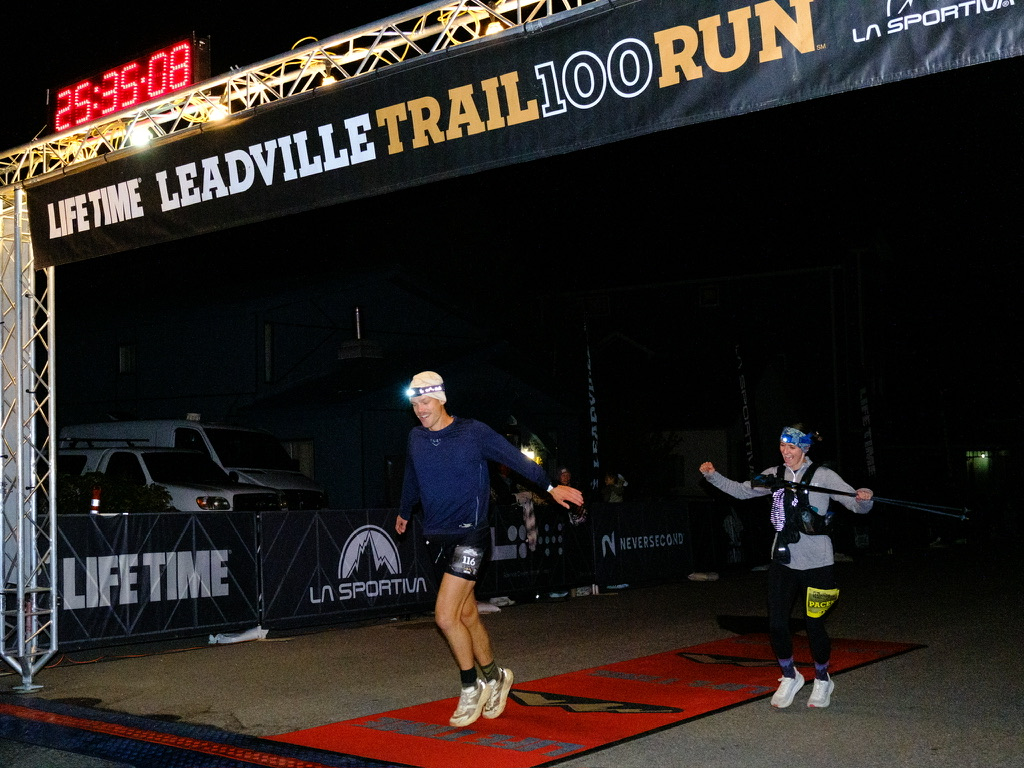
I'm stoked. That's the main takeaway from this race. I'm super super stoked.
This race just went really well. It was the best ultra I've ever run, by a lot — a stepwise jump above the next best one, not just a gradual improvement. Learnings from a lot of different races and runs all landed at once here, and almost every one of them hit.
Predicted split analysis
| Mile | Place (of 657) | Aid Station | Predicted | Actual | Diff |
|---|---|---|---|---|---|
| 10.6 | 197 | Carter Summit | 5:51a | 5:57 AM | +6m |
| 20.5 | 191 ↑ | Turquoise Lake Dam — out | 7:40a | 7:44 AM | +4m |
| 26.0 | 172 ↑ | Outward Bound — out | 8:34a | 8:43 AM | +9m |
| 31.8 | 183 ↓ | Half Pipe — out | 9:42a | 9:52 AM | +10m |
| 40.5 | 176 ↑ | Twin Lakes — out | 11:47a | 11:54 AM | +7m |
| 45.6 | 166 ↑ | Hopeless — out | 1:54p | 1:55 PM | +1m |
| 52.3 | 146 ↑ | Winfield | 4:02p | 3:55 PM | -7m |
| 59.1 | 150 ↓ | Hopeless — in | 6:48p | 6:45 PM | -3m |
| 64.2 | 149 ↑ | Twin Lakes — in | 8:11p | 7:55 PM | -16m |
| 72.8 | 129 ↑ | Half Pipe — in | 10:44p | 10:37 PM | -7m |
| 78.7 | 122 ↑ | Outward Bound — in | 11:54p | 11:55 PM | +1m |
| 84.2 | 112 ↑ | Turquoise Lake Dam — in | 1:07a Sun | 1:15 AM Sun | +8m |
| 100 | 116 ↓ | Finish | 4:59a Sun | 5:35 AM Sun | +36m |
Going in, I built three sets of splits: an A-goal (25 hours, everything goes perfect), a B-goal (27 hours, what I actually thought was realistic), and a C-goal (the official cutoffs — just finish the thing).
I mapped those across the aid stations by working with Claude. I fed it a few of my previous races — last year's Leadville 50, this year's Canyons 100k, Rock the Ridge — full GPX files and all, and had it learn how I run on flats, downhills, and climbs, and how I fade over the course of a race, especially on climbs versus flats. Then I pointed it at the Leadville course, had it account for the altitude, the extra distance, and the fact that I was in better shape, and told it to target a 25-hour finish, then iterated a bit after it gave some results. What came back wasn't just an average — it was grounded in actual data on how fast I move on different terrain, projected out to what a perfect day at Leadville could look like for me specifically.
The splits above are that perfect-day set, the A-goal. And it turns out I had exactly that kind of day, and it did a genuinely good job predicting when I'd hit each spot, which is kind of awesome and kind of crazy.
Looking back, there are two things I'd change with the model for next time. First, the climbs. I thought the steep climbs were one of my weaker parts of the course. I felt like I was crawling, making no progress at all. But that's actually where I was gaining time relative to the model, which feels backwards from how it felt in the moment.
Second, the end. I was pushing as hard as I could, but I don't think the model fully accounted for the wear and tear that many miles put on me — or maybe that's just me not being in as good shape as I could've been. Either way, it had me moving faster than I actually could over the last sixteen miles, and really the last twenty-two to twenty-five miles from Outward Bound on.
Still, crazy how close it was overall. I was super stoked looking at this.
Looking forward, where could I have improved the most? That first 26 miles — I ran it super conservatively. I split the marathon at 4:43, which is nothing for me, effort-wise. Sure, there are climbs, two aid stations, some walking built in, but 4:43 is still way conservative. I think I was scared of the rest of the race, scared of trashing my legs for what was coming. That's fair, but also kind of dumb. I should run that harder next time — have more faith in the training, more faith that the vert and the distance are going to be fine, and just send it a bit more through the first 40 miles.
That said, these were my aggressive splits — I didn't know yet that I'd be having the day I was having, so I was pacing to where I thought I'd land. Looking back, I was chilling at mile 26 when I could've been working a bit harder and banking time, though I don't think it would've changed the finish. For next time, on both the pacing and the projections: build in a bit more fade late, and go out with a bit more trust early.
Placing
I generally don't care what place I finish these races, especially this one — the field is huge, the race is long, and I'm mostly just running my own race, not worried about anyone else. But it is a decent relative indicator of how I'm doing, and this race shows that pretty clearly. I went out relatively slow over the first 26 miles, then steadily moved up all day. Never any massive jumps — it always felt under control, just steady climbing. And that's net, obviously; I was getting passed some too, just passing more.
The stretch I noticed it most was with Brooks, Twin Lakes inbound to the Dam — twenty miles where it really felt like we were just passing people, passing people, passing people. Maybe got passed once or twice ourselves, nothing more. The numbers back that up: I moved from 149th to 112th over those twenty miles, which is exactly what it felt like.
From the Dam to the finish I dropped a few places. Some of that might be tracking noise — it says I dropped seven spots in the last mile, but I didn't see anyone out there, and no one was within fifteen minutes of me. It still felt like we were closing on people the whole way, but I finished 116th, so who knows. Either way: the places are the places. I never really thought about racing anyone or passing people out there, but it's kind of cool in hindsight to see the relative speed — how well I ran compared to everyone else who was out there.
The math
My time was 25:35, or 1,535 minutes. If I'd had a perfect day, everything strung together exactly as planned, I think I could have run 24:59 — 1,499. So I was thirty-six minutes off a perfect day. That's 2.3%. I ran the race at 97.7% of the best version of it, which is pretty dang good, and I'm not too mad about that.
I don't think I left much out there. The one real spot was my feet. If I'd gotten them taken care of at Twin Lakes outbound, I probably wouldn't have had to stop at Winfield as long as I did — that turned into a sixteen or eighteen minute stop. I didn't need to be there that long: water, refuel, a bite, back on the road. Instead I had to sit and deal with my feet. That's the biggest place I actually gave time away, and it's pretty easily addressable next time.
The aid stations otherwise I kind of crushed. The three long stops — Twin Lakes out, Winfield, Twin Lakes in — ran about fifteen minutes each. Across the other ten I spent twenty minutes total, so around two minutes apiece, which for me is about all you can ask for. Winfield I wish I'd spent less time at. Twin Lakes I think I actually needed, both times, as a reset and a gear-up for what was coming: Hope Pass, and then the night.
I had a chance at 25 hours. Didn't quite get there, and that's okay. I ran super well and I pushed very much as hard as I could. I have no regrets about it. Zero.
The block
I put in a lot of training for this one — by far the most I've ever done, and it obviously paid off. I knew I was in good shape going in. I had the legs. The long runs were coming easily.
I settled into a steady state of sixty-eight to seventy-five miles a week, with somewhere between five and ten thousand feet of climbing. For living in New York City, not bad. Obviously not great. I did more climbing during the race than I was doing in a week here, and more miles in the race than I was doing in a week here.
I also planned a lot more for this race. Course recon, drop bags, crew bags. Going out a week early was a complete game changer. But there are people going out six weeks early, and people who live in Colorado, in the mountains, who are just out there way more. If I'd run the whole course ahead of time, on top of being at altitude longer, I'd have been more prepared.
None of that is a regret for this race. I did what I could for this race, and it was a step change from my previous blocks and previous races — fitness going in, planning, execution. It's more that it got me excited about what's next.
More
So far I've basically been training and running like an amateur runner, which is what I am. But semi-pro doesn't feel unachievable, and I think that's interesting. I have the appetite to get there. When I think about what the big gaps are, it comes down to one word: more.
More miles. This block is what I relied on and what I was proving out: running more miles equals running faster in ultras. Such an obvious thing to say, and not always obvious in practice. I can take it a step further. A hundred to 120 a week in the next eighteen months isn't achievable. Ninety is. Going from seventy to seventy-five with a peak at eighty-eight, to ninety to ninety-five with a peak over a hundred, is a big difference in fitness at the start line — and it's realistic, which is a big point.
More vert. Five to ten thousand feet was the most I've ever done, and I'll take it for this block: one treadmill session and one trail session in the weeks I got a good chunk in. But fifteen to twenty thousand instead makes the climbs easier and leaves the legs less beat up, especially on the downhills. Ben Dhiman before UTMB was doing 15k METERS a week. I'm not gonna win UTMB any time soon, but still. I can do more.
More trails. I just don't have my trail legs. Living in New York it's so hard. I did maybe seven or eight trail runs the entire block, which is nothing for an ultra block — there are people I'm racing who do that in a week. How am I supposed to compete with that without getting to that level?
More speed. I did no speed work for this race. I needed miles and I needed vert much more than I needed speed. I was fast enough. I ran sub 3 in the marathon, and my ultra times were much slower than my marathon time. I just needed miles and vert for this block. But I'm looking forward now. If I had to guess, somewhere between 65 and 75% of the people who beat me at Leadville could also beat me in a 5k. They could probably beat me in a marathon too — distances in a completely different scope to what we're talking about here. That's just me being too slow. You're not going to outrun your speed. You can fail to reach it, which is super common, but you almost never beat it. I ran to my speed at Leadville. To make the next jump, my speed has to move. If I'm in 2:45 marathon shape (much less 2:35...), threshold pace drops, everything gets easier, I move better on the trail, and I split that opening marathon in 3:45 instead of 4:45. There's an hour right there, and 3:45 would feel pretty effortless, in theory.
More weights. Literally zero sessions for this race. I don't need to be in the gym six days a week — two, even thirty or forty-five minute sessions would make a huge difference for these trail races. Going from zero to not-zero is the step change.
Fueling
I mostly did a good job here, though probably low on calories, which cost me a little. I took the first four or five hours super conservatively, which was what I needed to do for this race. But thinking forward, there's some opportunity in pushing higher carbs through that stretch.
What's next
I'm not sure what's next. What race, what goal — I don't know yet. Right now I'm just enjoying this one. There's going to be a next, but it's not clear what it looks like.
Watching UTMB this past weekend didn't help narrow it down, either. Ben Dhiman — an absolute legend — won it and beat the previous fastest winning time in the race's history by nearly forty-five minutes. My takeaway: aim bigger, go a lot harder. I didn't go that hard for this race. Harder than I've gone before, sure, but there's a lot more left out there.
I don't know exactly what that looks like yet, but I feel like I've barely tapped into where I could be. This race was a stepwise change, a big jump over the previous ones. There are definitely more steps out there.
Marathons make it easy to set goals — you're shooting for a time. Hard to hit, but easy to define. Ultras are harder. And that also means the goal means less. Sub-25 at Leadville was kind of arbitrary; it wasn't really a goal, and I didn't get it, and I'm not that mad about it. If I'd missed a sub-three marathon, I'd have been upset. Missing sub-25 at Leadville, if anything I'm the opposite — the race went so well that I don't even care about the time.
So how do you build goals that still mean something, that you can still strive for? I don't think I even had a real goal for Leadville, because I didn't know what I was capable of. Now I've gotten a taste of it.
I think what I want is the jump from amateur to whatever's next. In the marathon, there are guys running 2:30, 2:25, 2:20 — borderline semi-pro, maybe a little faster. What does that look like in ultras? Isaac finished twelfth at Leadville in just under 20 hours, 19:48 or so. Is that the equivalent? Pretty legit. Not pro — you're not competing for wins, Nike isn't calling — but you're sniffing it. I don't think I could run 2:20 in a marathon, but could I do the equivalent in an ultra? Who knows.
I'm not sure that level is unachievable for me. I think I could get there. It's gonna take a lot more years and a lot more miles, probably moving to Colorado. But maybe that's where I need to be. Maybe that's what's next — actually going for it, treating it like a sport instead of a hobby.
I don't think top 10 at Leadville is impossible.